Please wait, loading...

 
Monday - Friday8AM - 5PM
OfficesJumsie Jewellery House,6B Funke Fadugba Street,NUJ Estate Phase One Arepo
Visit our social pages

TRINITRA Consulting ServicesOur Services

Consulting
  •  Provide useful professional service that helps managers to analyse and solve practical problems faced by their organizations, improve organizational performance, learn from the experience of other managers and organizations, and seize new business opportunities
  •  Implementing changes by being “Change agents” is another label frequently given to consultants. We are proud to be referred to in this way since this is a reflection of another general purpose of consulting: helping client organizations to understand change, live with change and make changes needed to survive and be successful in an environment where continuous change is the only constant.
  •  Adding value to create, transfer, share and apply management and business knowledge in two dimensions
  • The technical dimension, which concerns the nature of the management or business processes and problems faced by the client and the way in which these problems can be analysed and resolved. Its protagonists are technicians competent in providing advice on business processes, strategies, structures, systems, technology, resource allocation and utilization, and similar tangible, quantifiable and measurable issues
  • The human dimension, i.e. interpersonal relationships in the client organization, people’s feelings about the problem at hand and their interest in improving the current situation, and the interpersonal relationship between the consultant and the client. Organization development (OD) and human resource development (HRD) consultants are typical representatives of this second type.
  • Provide advisory and business consultancy services of a general nature to sales and marketing in respect of development and deployment of best in class policies, processes and procedures.
  • Define the purpose, not the problem. We achieve breakthroughs for our clients by focusing on a series of incrementally larger purposes to be achieved.
Advisory
  • Responsibility is for the quality and integrity of the advice; the clients carry all the responsibilities that accrue from taking it.
  • Assistance can also cover services that are not consulting per se like Outsourcing
Executive Coaching & Sounding board
  1.  Creation of a one-on-one relationship between an executive who holds a leadership position and a professional executive coach. These relationships are intended to benefit the executive by increasing his or her performance and helping them to reach untapped levels of success.
  2. Our executive coaches help the executive identify their goals, understand the best way he or she can approach challenges and show the highly complex decisions that make up their work, as well as helping them to alter their communication style to work as a better manager and leader in the office.
  3. We are qualified professionals that works with individuals (usually executives, but often high potential employees) to help them gain self-awareness, clarify goals, achieve their development objectives and unlock their potential.
  4. We help heighten awareness of the difference between a “problem executive” who can be trained to function effectively and an “executive with a problem” who can best be helped by psychotherapy.
Training
  • Management training is training activity that focuses on improving an individual’s skills as a leader and manager. There may be an emphasis on soft skills, such as communication and empathy, which enable better team work and more progressive relationships with the people they manage.
  • Leadership skills, such as development a progressive style to engage employees, could also be a focus, although this will probably be called leadership training.
  • Management training may also focus on the business side of being a manager such as reporting to senior leaders, more effectively leading performance reviews and talent acquisition (where responsibility for recruitment falls with managers).
  • Those undertaking management training may be introduced to, or re-trained in, common management techniques, such as balanced scorecards.
  • Proper management training teaches much more vital skills needed to keep employees motivated, productive and committed to the company. … A manager who knows how to properly communicate direction and assign tasks helps employees to be more productive, with less need for overbearing micromanagement.
Capacity building
  • Capacity building or as we also call it capacity development is the process by which individuals and organizations obtain, improve, and retain the skills, knowledge, tools, equipment, and other resources needed to do their jobs competently.
  • It allows individuals and organizations to perform at a greater capacity (larger scale, larger audience, larger impact, etc).
  • The only work that is really worth doing as a consultant is that which educates, which teaches clients and their staff to manage better for themselves
  • We help conduct an assessment of capacity building.
  • We develop Capacity Building Response Plan including:
  • Institutional arrangements review in terms of bad or weak policies, procedures, resource management, organization, leadership, frameworks, and communication.
    2. Leadership – We believe leadership is completely different from Management. Strong leadership allows for easier adaption to changes, strong leaders can also influence people. We use Leadership training, coaching and mentoring programmes to help encourage the development of leadership skills such as, priority setting, communication and strategic planning.
    3. Knowledge – Knowledge is the foundation of capacity. Greater investments should be made in establishing strong education systems and opportunities for continued learning and the development of professional skills. We provide and support on the job training and capacity building and virtual learning systems with ICT enabled learning.
    4. We develop standardized training and capacity building ladders for levels of line and functional organization
    5. Accountability – The implementation of accountability measures facilitates better performance and efficiency. A lack of accountability measures in institutions allows for the proliferation of corruption.
    VI. Implement a capacity development response
    VII. Evaluate capacity development
bt_bb_section_bottom_section_coverage_image
STRAIGHT TALK, GOOD BUSINESS

Client focused,
Results driven

Solutions and services
  • Complaining clients high staff turnover
  • poor business results unrealistic self-image
  • unexpected loss lack of cash
  • natural disaster idle resources
  • loss of important market pressure of competition
  • lack of perspective failure to meet targets
  • obsolete control system lack of self-confidence
  • wrong investment choice excess of self-confidence
  • missed opportunity slowness of action
  • reluctance to change internal conflicts
  • identifying and seizing new opportunities
How we can be of help

a. providing information
b. providing specialist resources
c. establishing business contacts and linkages
d. providing expert opinion
e. doing diagnostic work
f. developing and managing organizational changes
g. training and developing management and staff
h. counselling and coaching
i. action proposals
j. developing systems and methods
k. planning

Ways of working with you

I. Independent private firm
II. internal consulting
III. Advisors
IV. Management development of internal manager

Our Consulting Engagements
  • A Consulting Assignment
  • A Retainer Arrangement
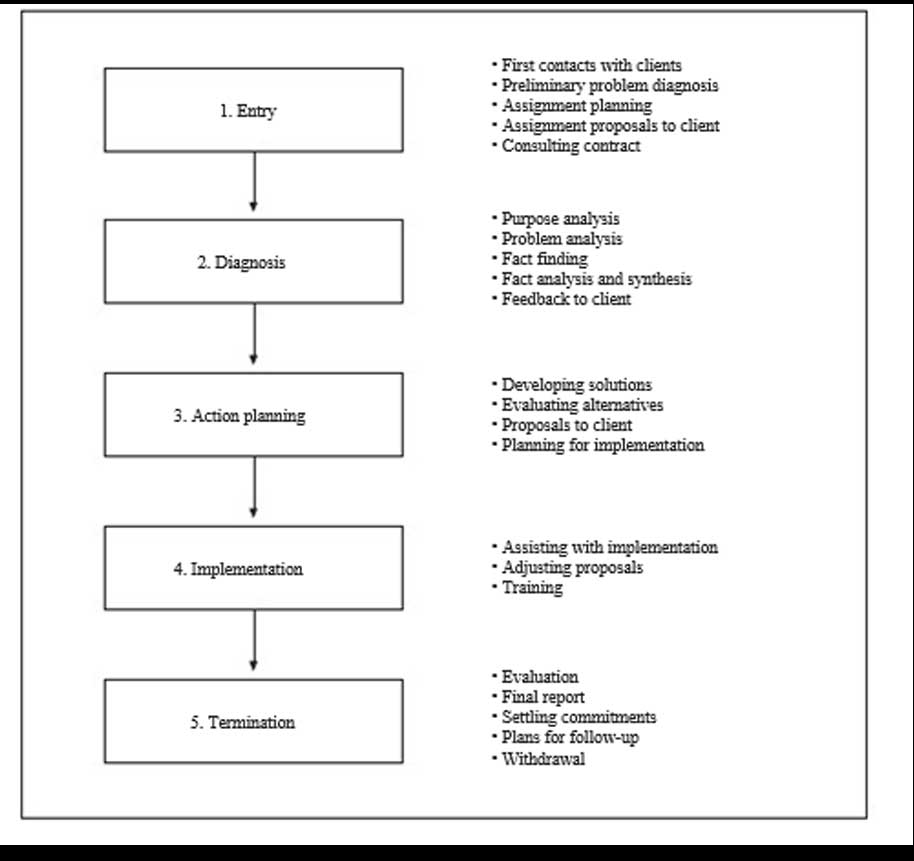
  • Phases of our Consulting Process

I. the purposes (objectives, results) to be achieved
II. the expertise to be provided by the consultant
III. the nature and sequence of tasks to be undertaken by the consultant
IV. the client’s participation in the assignment
V. the resources required
VI. the timetable
VII. the price to be paid
VIII. other conditions as appropriate

I. Under a retainer contract, the client purchases in advance a certain amount of the consultant’s time.
II. The nature and purpose of the work to be done are defined in general terms only and will be specified at the beginning of each period covered by the contract. Collaboration extends over a longer period of time, using a cost-effective format.
III. For example, the client may use the consultant’s services for two days during the first week of every month to review jointly the general situation of the business, the problems and opportunities that have developed and the key decisions that will have to be taken.
IV. Or the agreement may define a more or less regular task for the consultant (e.g. assisting management in preparing board meetings) without specifying in advance the time to be spent.

V. Two types of Retainer Arrangements:
1. Generalist retainer
a. under which the consultant follows global results and trends of the client’s business, looking for opportunities for improvement in various areas and feeding the client with new information and ideas.
2. Specialist retainer
a. providing the client with a permanent flow of technical information and suggestions in an area where the consulting firm is particularly competent and advanced (e.g. computer systems, quality management, international financial operations, identification of new markets)

https://trinitra.com.ng/wp-content/uploads/2019/11/processbig.jpg
https://trinitra.com.ng/wp-content/uploads/2019/11/plann22.jpg
bt_bb_section_bottom_section_coverage_image
MORE THAN JUST BUSINESS

Great Clients
Awesome Reviews

Phosfluorescently engage worldwide methodologies with web-enabled technology. Interactively coordinate proactive e-commerce via process-centric outside the box thinking.
  • Consulting Club Partners
  • Scope of Professional Services
  • Consulting in general and strategic management
  • Consulting in other sectors

a. Generalists
b. Specialists
c. Industry giants
d. Consulting academics
e. Glocal

a. Consulting in different areas of management and business
I. Consulting in company transformation
1. What is organizational transformation?
2. Preparing for transformation
3. Strategies and processes of transformation
4. Company turnarounds
5. Downsizing
6. Business process re-engineering
7. Outsourcing and insourcing
8. Joint ventures for transformation
9. Mergers and acquisitions
10. Networking arrangements
11. Transforming organizational structures
12. Ownership restructuring
13. Privatization
14. Pitfalls and errors to avoid in transformation

I. Nature and scope of consulting in corporate strategy and
II. general management
III. Corporate strategy
IV. Processes, systems and structures
V. Corporate culture and management style
VI. Corporate governance

Consulting in financial management
I. Creating value
II. The basic tools
III. Working capital and liquidity management
IV. Capital structure and the financial markets
V. Mergers and acquisitions
VI. Finance and operations: capital investment analysis
VII. Accounting systems and budgetary control
VIII. Financial management under inflation
IX. Cross-border operations and the use of external financial markets

Consulting in marketing and distribution management
I. The marketing strategy level
II. Marketing operations

Consulting in commercial enterprises
I. International marketing
II. Physical distribution
III. Public relations
IV. The human aspects of operations

Consulting in human resource management
I. The changing nature of the personnel function
II. Policies, practices and the human resource audit
III. Human resource planning
IV. Recruitment and selection
V. Motivation and remuneration
VI. Human resource development
VII. Labour–management relations
VIII. New areas and issues

Consulting on productivity and performance improvement
I. Shifts in productivity concepts, factors and conditions
II. Productivity and performance measurement
III. Approaches and strategies to improve productivity
IV. Designing and implementing productivity and performance
V. improvement programmes
VI. Tools and techniques for productivity improvement

Consulting in operations management
I. Developing an operations strategy
II. The product perspective
III. The process perspective

Consulting on the social role and responsibility of business
I. The social dimension of business
II. Current concepts and trends
III. Consulting services
IV. A strategic approach to corporate responsibility
V. Consulting in specific functions and areas of business
VI. Future perspectives

Consulting in small-business management and development
I. Characteristics of small enterprises
II. The role and profile of the consultant
III. Consulting assignments in the life-cycle of an enterprise
IV. Areas of special concern
V. An enabling environment
VI. Innovations in small-business consulting

Consulting for the informal sector
I. What is different about micro-enterprises?
II. Management problems of informal-sector entrepreneurs
III. The special skills of micro-enterprise consultants
IV. Outreach to micro-enterprises in the informal sector

 Consulting for the public sector
I. The evolving role of government
II. Understanding the public sector environment
III. Working with public sector clients throughout the
IV. consulting cycle
V. The service providers
VI. Some current challenges

https://trinitra.com.ng/wp-content/uploads/2019/11/done.jpg
TRINITRA CONSULTINGNigeria Office
Jumsie Jewellery House,6B Funke Fadugba Street,NUJ Estate Phase One Arepo , Ogun State – Nigeria
OUR LOCATIONSWhere to find us?
https://trinitra.com.ng/wp-content/uploads/2020/11/img-footer-map2.png
GET IN TOUCHTrinitra Social links
Trinitra Nigeria LimitedHeadquarters
Integrity,Innovation,People,Reliability,Respect,Service to others, Results
OUR LOCATIONSWhere to find us?
https://trinitra.com.ng/wp-content/uploads/2019/04/img-footer-map.png
GET IN TOUCHTrinitra Consulting Social links
Integrity,Innovation,People,Reliability,Respect,Service to others, Results

Copyright by TRINITRA Consulting. All rights reserved.

Copyright by TRINITRA Consulting. All rights reserved.